Clearing the Rows
There are several closely related games that can be seen as variations of the same basic solitaire. All of them are played with a standard set of 32 Chinese domino tiles and use Classic triplets.
Guo Wu Guan (過五關) - Passing Five Levels
In this version, the tiles are arranged in seven rows.
The top row is the row of generals, consisting of six tiles. At the start, only the two outer tiles are available; the others are placed face down and revealed during play.
Below this are five rows of five tiles each — these are the “five levels”. Finally, one remaining tile is placed in a seventh row at the bottom, called the common row.
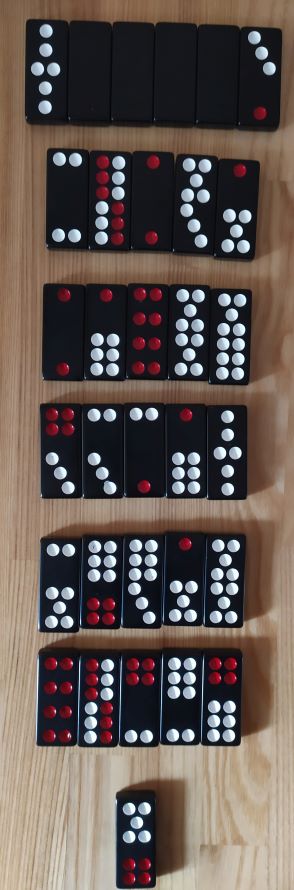
Example of the Guo Wu Guan deal
Structure of a Move
Each move consists of three phases:
1. Forming triplets within the levels
Starting from the top level and moving downward, the player may remove three adjacent tiles from a level if they form a valid triplet. The leftmost and rightmost tiles in a row are considered adjacent.
This means the triplets may be formed from tiles in the middle of a row, from one edge, or wrapping around both edges. Any triplet formed this way is placed on the left side of the common (bottom) row.
If a level becomes empty at this stage, it still remains in play.
2. Killing a general
If a level has exactly two tiles left, and together with one of the outer generals (the leftmost or rightmost tile in the generals row) they form a valid triplet, that general is considered “killed”. The triplet is placed in the common row (again on the left), and that level is considered completed and removed from further play.
At some point in the game, there must be a situation where a triplet is formed by a single level tile and two exposed generals. Since there are six generals and only five levels, one of the captures must involve a “double kill” of two generals at once.
Refilling the levels
Tiles from the right side of the common row are then distributed to all levels still in play, starting from the lowest level and moving upward.
It may happen that there are more active levels than available tiles in the common row. In that case, the higher levels simply do not receive tiles.
Note that a level may be empty but not yet completed; in such a case, it can still receive a tile during this phase.
Winning and Losing
The game is won when all six generals are killed and all five levels are completed.
The game is lost if the common row becomes empty and no further triplets can be formed.
Rule variations
There are several variations of this game.
One common modification removes the requirement that tiles forming a triplet must be adjacent. In this version, any three tiles within a level may form a triplet. This increases the chances of winning, though it may take longer to search for valid combinations.
O-Koan (Korea)
A very similar game was once played in Korea. According to Stewart Culin, it was a popular intellectual pastime, somewhat comparable to modern crossword puzzles. The game was called O-Koan and was played almost identically, with a few differences:
- Each of the five levels started with four tiles instead of five.
- The remaining twelve tiles formed the common row.
- There was no row of generals, and therefore no “killing” phase.
- A level was completed simply when it became empty.
One advantage of O-Koan is that searching for triplets within a level is easier. At the beginning, all tiles are external (since there are only four per level), and later any triplet in the middle of the level appears only because the player overlooked it earlier.
Clear Five Levels (通五关)
A modern version closely resembling O-Koan is called Clear Five Levels. In this variant:
- Each level starts with six tiles instead of four.
- The common row begins with two tiles.
Otherwise, the gameplay is the same.
Seven Captures of Meng Huo (七擒孟获)
Another variation is called Seven Captures of Meng Huo.
In this version, the general is always the tile [2:1], representing Meng Huo. There are seven levels with three tiles each, and the common row begins with ten tiles.
Each time the general is captured, he is placed in the common row as usual. However, when tiles are redistributed to the levels, the general “escapes” and returns to the generals row — symbolically escaping from prison.
Since there are seven levels, Meng Huo must be captured seven times, which explains the name. Meng Huo is a historical figure who, according to legend, was captured seven times during a military campaign because of his overly self-confidence but was repeatedly released.
Sources
Rules description on Pagat
O-Koan description by Culin
Rules description on Chinese Wikipedia