Classical Triplets
Chinese dominoes can be grouped in different ways. So far, we have seen groupings of two - in pairs, which is explained in more detail in the article Tiles and pairs hierarchy . In some games, it was possible to group three dominoes if their sum is divisible by 10 without a remainder (such as in Tau Ngau , or Tsung Shap ).
There is another way to group three dominoes, known as Triplets, or Classical Triplets. In Chinese sources, this appears as 宣和牌谱. This system is used in certain games and for fortune-telling, and it likely originated from the latter.
To understand triplets, consider each tile as two halves, which we will call values. A triplet then consists of six values. What matters is not which tiles form the triplet, but which values are present. For example the triplet [1:2][2:3][1:3] is considered the same as [1:1][2:2][3:3] because the set of values in both is identical, even though the tiles differ.
There are nine types of triplets, which can be divided into three groups.
The first group includes triplets with exactly three identical values (not more):
- Five points (五點) – three identical values, the sum of the remaining values gives exactly five, for example [6:3][6:6][1:1]
- Full fourteen or Speed (正快) – three identical values, the sum of the rest is fourteen or more, for example [6:5][6:5][5:3]
- Split (分相) – three identical values and three more identical values, for example [3:3][3:1][1:1]
The second group includes triplets in which there are more than three identical values:
- Coincidence (合巧) - four identical values, and the sum of the remaining two values coincides with this same value. That is, for example [5:5][5:3][5:2] is four fives, and the sum of 3+2 is also five. Or [2:2][2:2][1:1]
- Five sons (五子) - five identical values, the sixth value does not play any role. For example [6:6][6:6][6:3]

Examples of triplets: Five sons, Coincidence, Split, Five points and Full Fourteen
The third group includes the so-called “dragons”, where there are less than three identical values.
- Full Dragon (全龍) – all values are different, for example [6:1][5:4][3:2]
- Big Dragon (大龍) – two sixes, two fives and two fours, for example [6:5][6:5][4:4]
- Little Dragon (小龍) – two ones, two twos and two threes, for example [1:1][2:2][3:3]
- Two-Three-Kao (二三靠 or 双飞燕) – two twos, two threes and two sixes. For example [6:3][6:2][3:2]
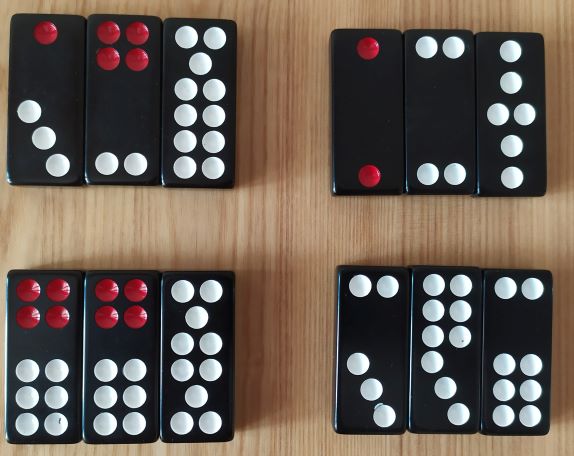
Example of Dragons: Full, Small, Big and 2-3-Kao
The history of Classical Triplets is hard to trace. Most information exists only in Chinese sources, and separating fact from fiction is challenging. These combinations were culturally significant, often given poetic names and even written about in poems. For instance, the combination [5:5][5:1][5:5] resembles a sunrise between plum blossoms, which became its poetic name.
Classical Triplets are the standard combinations. Some games introduce additional triplets that supplement or replace these classics. These will be explained in the relevant game sections.
Triplets were also used in fortune-telling. The simplest method was to lay the dominoes in a row and observe which triplets appeared. Special books explained the meanings of these triplets.