Ding Niu
Deck composition
In Ding Niu (頂牛, “Bull Fight”), all military tiles are removed except for [6:3] and [6:2]. Specifically, the following tiles are excluded:
[1:2], [1:4], [2:3], [2:4], [2:5], [3:4], [3:5], and [4:5].
Please note: all tiles containing sixes are retained. After removal, 24 tiles remain — and half of them are doubles.
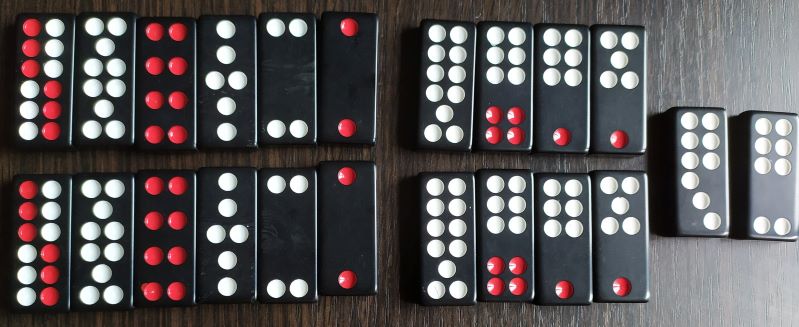
Deck for Ding Niu
The resulting deck is highly asymmetrical. Excluding doubles, the distribution of numbers is:
- One “two”
- Two “fours”
- Three “threes”
- Four “fives”
- Six “ones”
- Eight “sixes”
Because Ding Niu is a connecting game, this asymmetry significantly affects play. Each number acquires its own strategic character.
All tiles in this reduced deck are duplicated, except for the already mentioned [6:2] and [6:3].
Interestingly, in another unrelated game, Mo Hua Hua (抹花花), these two tiles together are known as the “bull pair.” Perhaps the oblique two and oblique three resemble the horns of a bull on the large six-dot body. We will encounter this pair again later.
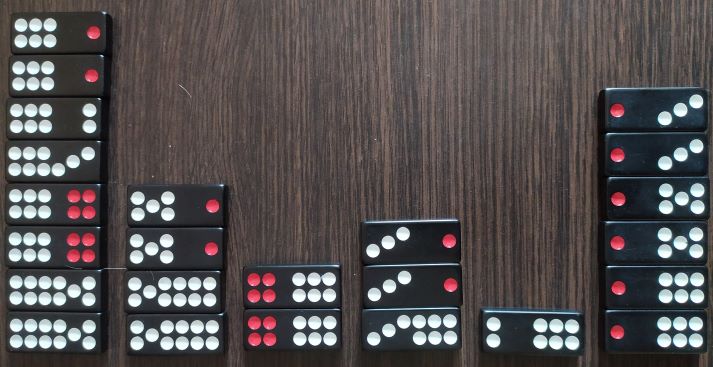
Ding Niu deck assymetry (two decks were used for display)
Rules
Ding Niu is played similarly to Jie Long (please read the basic rules of Jie Long first if you haven’t done so already).
- Four players participate.
- Each player receives six dominoes.
- Tiles may be added to either end of the layout.
- A player cannot fold when he has a playable tile.
Also there’s a special restriction for the first tile played to prevent all the next players to pass on their first turn. If a player has all the tiles which contain some specific number and holds one or two doubles of this number, he can’t lead with that double. For example if a first player holds both [4:6], he can’t lead with [4:4]. This restriction is only for the first played tile
Even without special rules, the asymmetrical deck already makes the game interesting. However, the scoring system introduces additional complexity. Be warned: beginners may wish to ignore the advanced calculations at first.
Points calculation
There is one winner and three losers.
- The winner receives 6 chips.
- Second place pays 1 chip.
- Third place pays 2 chips.
- Fourth place (the player with the most points) pays 3 chips.
If two players tie for first place, preference is given to the lower hand (the earlier player in turn order; the first player is the lowest hand).
However, if players tie for all the lower positions, preference is given to the upper hand (the later player in turn order).
Example
Suppose the order of play is:
Adam → Boris → Celine → Dominik
(Adam is the lowest hand.)
If:
- Boris and Celine score 5 points each,
- Adam and Dominik score 10 points each,
Then:
- Boris beats Celine (lower hand advantage) and takes first place.
- Celine takes second.
- Adam and Dominik compete for third, but Dominik (upper hand) takes third place.
- Adam falls to fourth.
Calculation in chips follows:
- Boris receives 6 chips.
- Celine pays 1.
- Dominik pays 2.
- Adam pays 3.
Curiously, if Boris and Celine had instead scored 15 points each, Adam would beat Dominik and take the first place (because lower hand has priority in that case). The system is convoluted, but ties are relatively rare.
As in Jie Long, beginners may simply record points on paper and ignore the chip adjustments.
Blocking or SuanZhang
A distinctive feature of Ding Niu is SuanZhang (算含), a special form of blocking. The layout becomes blocked when no further non-double tiles (or, in some cases, no specific tiles - see below) can legally be played.
Blocking in Ding Niu is far more complex than in European dominoes. Because of the deck’s asymmetry, it is not enough simply to observe that, for example, all six “fives” are already on the table.
There are four primary SuanZhang types:
- Ones
- Two-Three (their counts are odd, so blocking with two-two or three-three is impossible)
- Fours
- Fives
Examples of blocked layouts are on the photos (note that it is easiest to block with fours).

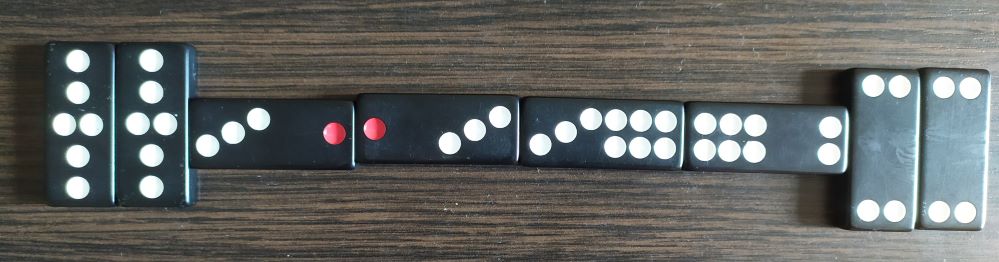
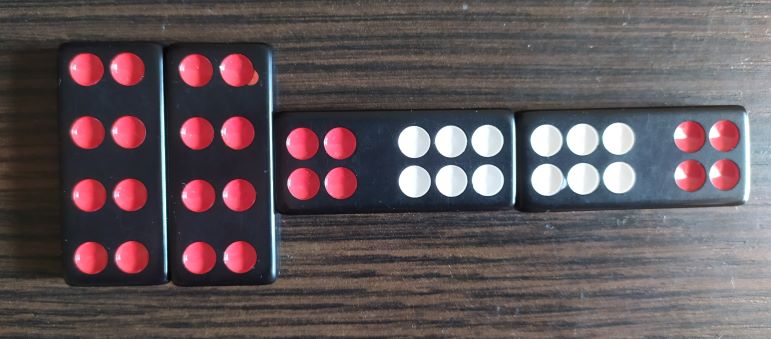
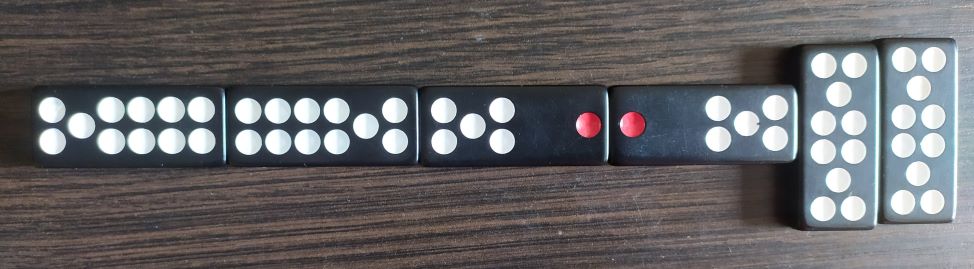
I will leave as an exercise for the reader why is it impossible to block with six-six.
In fact, there are even more difficult types of SuanZhang - when it is obvious that it is impossible to add fours or fives.
Here is a photo of how a SuanZhang looks like, in which it is impossible to add any more fives:

“Smothered fives”, no more tiles with fives can be added
The only remainding tiles with fives are [5:1], but since all “ones” are out (four are already on the table, and the remaining two are left on [5:1]), it is no longer possible to add fives. This is a special type of SuanZhang - Smothered Fives. This is not a typical blocking as in European dominoes, because the game could continue with other tiles by European rules. But in Ding Niu that’s a block.
Similarly, here is an example of the “Killed Four” SuanZhang:

“Fours” are out of the game
If the player who creates a SuanZhang:
- Wins (has the fewest points), then all payments are doubled. He receives 12 chips instead of 6.
- Loses, he must pay 12 chips to the winner, and the other players pay nothing.
SuanZhang can occur very early in the game. For example if one player plays [6:4], and another immediately adds the duplicate [6:4] connecting six to six, all non-double fours are already on the table. This creates SuanZhang.
Chinese sources are not entirely clear about whether doubles such as [4:4] may still be played in this situation. The strong impression is that doubles can still be added, but the blocking is attributed to the player who created the condition, and penalties or bonuses apply to him alone. This interpretation is supported by photographs showing SuanZhang positions where doubles were attached afterward.
The scoring system and especially the SuanZhang rules of Ding Niu are complicated for beginners. The Chinese themselves acknowledge this — but they also appreciate the complexity. In these intricate calculations and rare blocking patterns, they find the beauty of the game.
Sources
Rules on BaiDu - Chinese online encyclopedia