Connecting Games
The first type of Chinese domino games are Connecting Games, which are similar to what Westerners usually mean when they say “play dominoes.”
Typical games include:
- Jie Long (接龍) – “Connect the Dragon”
- Ce Deng (料釘) – “Oblique Nail”
- Kko-li-but-i-gi (꼬리붙이기) – Korean “Tails”
These are all variants of essentially the same game.
Basic rules
- Players: 4
- Tiles: Standard set of 32 dominoes
- Deal: Each player gets 8 tiles
- First move: Determined by lot in the first game; in subsequent games, the winner of the previous hand moves first. For simplicity, the right to move first can pass counterclockwise.
Gameplay:
- The first player places any tile on the table and declares which end is open. The other end is “closed” and does not participate in the game. It can be covered with a token.
- Each subsequent player must place a tile so that it matches the open end of the line (e.g., six to six, five to five, etc.).
- If a player cannot play, they place one tile face down in front of them and pass. From now on this tile does not actively participate in the game and is only used for scoring.
- The game ends when all tiles are placed or set aside.
- If the game is blocked both tiles in hands and face down tiles take part in scoring.
Scoring: The player with the fewest points (dots on face down tiles) wins. Settlement point between players varies between games.
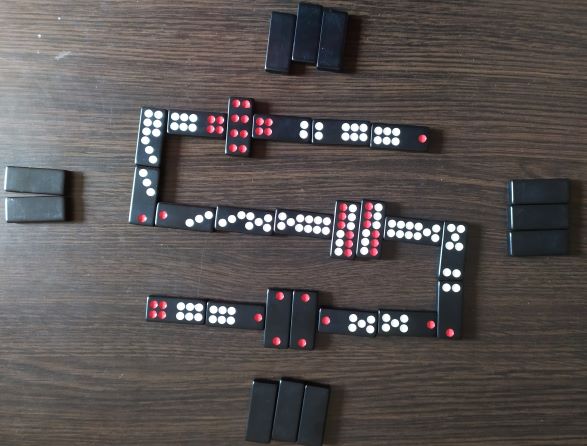
Example of a finished game
Special layouts: To save space, tiles can be stacked. For example, after the first eight tiles, the ninth can be placed on top of the eighth, eventually forming a “wall” four tiles high. Paper dominoes can also be stacked like a deck of cards.

Tiles can be put on top of each other
Differences from European Dominoes
- If the player cannot play a tile, he puts any tile face down.
- Tiles are usually played from one open end only.
- Doubles may be placed consecutively, unlike in European dominoes, which simply don’t have duplicates of doubles.
- Game is played until the end as in card games, not when one player runs out of tiles.
- There is no stock
- Blocking is different because of the asymmetric deck (some pip values are present in odd number) and the face-down tiles (not all tiles have to be in a layout).
- Tiles are typically played only from one side. However, some games have a “two-sided” variation.
Points calculation
To simplify gameplay, you can count points like in European dominoes: write down the points for each player and play up to a certain total or number of games. The following details are intended for those who already understand the basic rules and want a more authentic experience.
In traditional Chinese play, these games are often played for money, with players paying each other based on the difference in points after each round. For example:
- Anna has 2 points
- Bob has 12
- Celine has 34
- Dominic has 18
Bob pays Anna 10 units (12-2), receives 22 (34-12) from Celine and 6 (18-12) from Dominic. Anna, in addition to the 10 already received from Bob, also receives 32 from Celine and 16 from Dominic. Celine pays Dominic 16 units. As a result, we get:
- Anna gains 58 units
- Bob gains 18 units
- Celine loses 70 units
- Dominic loses 6 units
This is a typical calculation, but in practice it can be cumbersome. Often, games are simplified: for instance, the winner may simply receive one chip from each loser, as in the Korean game Kko-li-but-i-gi.
But what if the number of points is the same and two or more players want to claim a victory? In the classical calculation, this is not an issue—the players simply do not pay each other. But if you exchange chips, then the player with the lower hand gets an advantage (with the lowest hand belonging to the player who played first). Such an advantage of the “lower hand” is found in other games as well.
Also in Kko-li-but-i-gi, only the player with the highest score pays the winner, and other players pay only if their score exceeds 30 points.
In Ce Deng, point calculation is more complex due to bonuses.
If a player finishes cleanly (playing all eight dominoes without discarding), the points they receive are doubled.
The Head-7 / Tail-8 rule applies: the first player is the Head, and the others are Tails. If the Head discards seven tiles, or a Tail discards all eight tiles, payments are doubled.
The reason why the number for Heads is one less than that of Tails is obvious: in any case, the Head will play the first tile, that is, he cannot even theoretically discard all eight tiles.
In some variations, a stricter Head-6 / Tail-7 rule is used.
If someone finishes cleanly while another player is subject to the Head-Tail rule, points are multiplied by four (×2 for the clean game and ×2 for the Heads-Tails adjustment).
Additionally, in the game of Ce Deng, if a player has seven or more doubles in their hand during the deal, a redeal occurs.
Let’s summarize:
- Classic scoring is based on the difference in domino dots between players.
- Kko-li-but-i-gi usually has only one loser paying the winner, and offers a simplified chip-based option.
- Ce Deng includes penalties and bonuses for certain situations.
- In disputed cases, the lower hand has the advantage, with the first hand considered the lowest.
Fewer Players
The previous rules assume four players. How do these games adapt for fewer players?
- Ce Deng: strictly requires four players.
- Kko-li-but-i-gi: removes doubles from [3:3] to [6:6], creating a 24-tile deck.
- Three players → 8 tiles each
- Two players → 12 tiles each
Note: Kko-li-but-i-gi is Korean. The Chinese would not normally allow removing the double six, as it symbolizes Heaven. This cultural aspect will be discussed later.
- Jie Long: no tiles are removed.
- Three players → 10 tiles each (2 remain closed and are not played)
- Two players → 16 tiles each
Please note: Since some tiles are set aside during play and do not re-enter the game, it is impossible to know exactly which tiles remain in opponents’ hands.
Another connecting game is DingNiu (Bull Fighting) , but a separate page will be devoted to this game.
Sources
Chinese Wikipedia all games except for Kko-li-but-i-gi
Culin’s description of Kko-li-but-i-gi
Description of the games at Pagat