Ho-Hpai
The Korean game 胡牌 (Ho-Hpai) which is usually translated as Barbarian Tablets also named 톡 (Tok) is a Collecting game. It is played by three or four players with the standard 32-tile deck. The first player receives six tiles; the other players receive five each.
On a turn, a player either takes the last discarded tile or draws a face-down tile from the deck. After that, the player may either lay down a winning combination or discard one tile face up. If the player hasn’t won, then the play passes to the next player.
Ho-Hpai uses most of the classic triplets described earlier, though not all of them. The combinations Five Points and Full Fourteen are not used. The valid triplets are therefore:
- All Dragons (Full, Big, Small, and 2-3-Kao)
- Five Sons
- Coincidence
- Split
In addition, Ho-Hpai has its own special combinations: straights of six tiles, in which one value remains constant while the other increases from one to six. For example:
[4:1][4:2][4:3][4:4][4:5][4:6]
This is a straight “with fours.” Logically, there are six such straights, one for each fixed value.
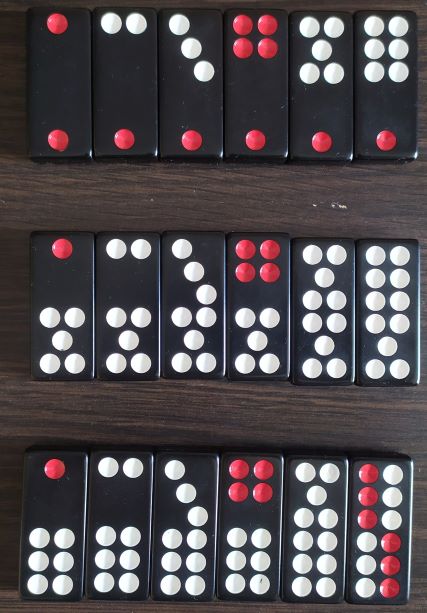
Straights examples with ones, fives and sixes
A winning hand consists of either two triplets or one straight.
The value of a winning hand is as follows:
- Two identical dragons (e.g., two Small Dragons, two Big Dragons, etc.) — 3 points
- Two Full Dragons consisting entirely of military tiles — 5 points
- A straight “with twos” — 5 points
- A straight “with threes” or “with fours” — 4 points
- The remaining straights — 3 points
- All other winning hands — 2 points
Two Optional Notes
The status of “sok” and “split” combinations
The combinations Five Sons and Coincidence are considered related, since both are ultimately based on five identical values (in the case of Coincidence, this requires summing two pips to produce the fifth). Together they are called “sok”.
Culin notes that sok combinations are sometimes excluded by agreement, as they are considered too easy to form. Thomas Son, a modern Korean enthusiast, plays with sok combinations included, but without the Split combination.
Reshuffling the discards
According to Thomas Son, if no one has achieved a winning hand, all discarded tiles are turned face down and reshuffled. This occurs after a player takes the last tile but before making their own discard. This procedure reintroduces tiles into circulation and makes a drawn game - possible under the classical rules - much less likely.
Confusion in the Rules
The rules presented above are my simplified reconstruction of Ho-Hpai. Why not simply reproduce the original rules?
The problem is that there are only two substantial sources describing this game. The first is Stewart Culin’s book, which has already been mentioned several times. The second is a Korean blog by Thomas Son, a contemporary enthusiast. Unfortunately, both sources present difficulties.
Ho-Hpai is arguably the game that Culin described most inaccurately.
For example, he recommends removing the doubles from 3 to 6 if three players are playing. But if those doubles are removed, it becomes impossible to form the straights from 3 to 6. Some combinations are clearly described incorrectly (for instance, he gives the Small Dragon as [3:3][3:2][1:1]). Others are described ambiguously, and careful analysis reveals that certain combinations are simply omitted.
The most serious issue concerns the drawing mechanism. Culin states that players draw from one side and discard to the other. If this procedure is followed strictly, a player will eventually be able to draw only the tiles they themselves discarded, but never those discarded by their opponents. This is not obvious at first glance, but it becomes clear if you test the system.
There are additional inconsistencies. Culin deals six tiles to each player, instead of five as is customary in similar Asian games. Instead of drawing a seventh tile and then discarding (as in Western card games), he instructs the player to discard first and then draw, meaning a player never holds more than six tiles. Even the valuation of straights seems questionable: statistically, straights with threes and fours are harder to assemble than those with fives, yet Culin assigns 4 points to fives and only 3 to threes and fours.
Overall, Ho-Hpai is the most confusingly presented game in Culin’s work.
On the other hand, Thomas Son plays a closely related modern game called Tok and actively promotes it. Since he actually plays the game, I tend to trust his version more. However, his rules are written in Korean, which makes interpretation challenging.
In Tok, the Split combination is omitted. Scoring is also more complex: the value of a combination may depend on what the second combination in the hand is. Thomas Son himself advises beginners not to memorize the full scoring table, but instead to count every combination as 1 point, reserving 2 points only for the Full Dragon. The straight values can also be memorized easily (with one difference from the values given above: the straight “with twos” is worth 7 points, not 5).
Another complication in Tok is settlement between players. There is a cumulative jackpot that grows with each game and can only be claimed if the winner wins by drawing a face-down tile. If the winning tile was taken from the discard pile, the winner collects payment only from the player who discarded it.
As for the Ho-Hpai description presented at the beginning of this section, it represents my attempt to combine both sources and simplify the calculations to make the game more accessible. For those interested in a more complex and historically faithful reconstruction, I will provide references to the original sources.
Sources
A blog by Thomas Son with few English texts