Tsung Shap
Tsung Shap (對十) - “Dispute for Tens” - differs noticeably from other fishing games. Most importantly, tiles may be captured only from the two ends of the layout.
Two players take part. Each receives 16 tiles, placed face down in front of them. During the first move, each player draws one of their face-down tiles and places it on the table; these two tiles form the initial layout.
Players keep their tiles face down and turn them over only when playing them. Thus, unlike most domino games, they do not know in advance which tile they will play.
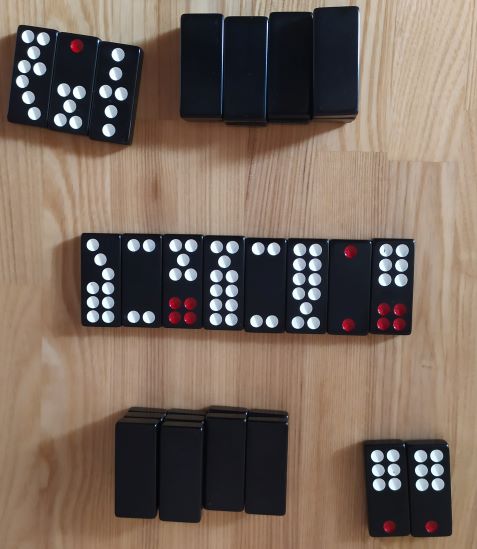
Game in progress
On each turn, a player:
- Turns over one of their face-down tiles.
- Adds it to either the right or the left end of the layout.
The following rules then apply:
If the newly placed tile is identical to a tile at either end of the layout, the player captures both tiles. Each spot in such a pair counts as 10 points.
If the newly placed tile, together with the two extreme tiles (two on the right, two on the left, or one on the right and one on the left), produces a total divisible by ten, the player captures all involved tiles. These tiles are counted at their actual pip total (10, 20, or 30).
If there were only two tiles on the table and the player captures both with their tile, the three tiles are scored as 40 points, regardless of their pip total. These tiles should be marked separately (for example, stacked), to avoid confusion later. After clearing the table, the player immediately places another tile to restart the layout.
If no capture is possible, the tile simply remains on the chosen end of the layout.
If a player fails to notice a possible capture, the opponent may claim it instead.
The game continues until one player runs out of tiles. At that moment, play stops and points are counted.
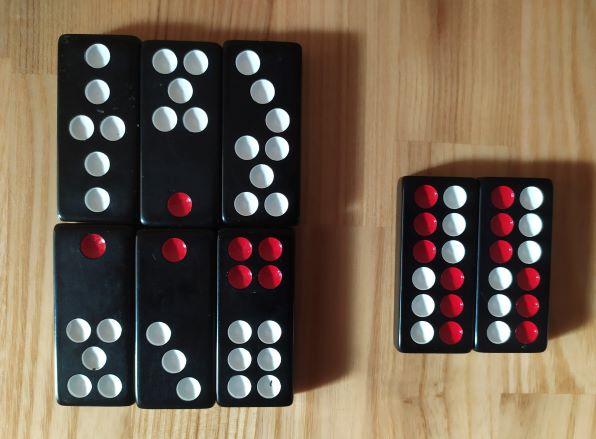
Example of a catch
The photo shows an example of a catch - two groups of three, each counting 20 points. Plus one pair of identical tiles, there are a total of 24 dots, multiply by 10, a total of 240. This catch counts for 280 points.
Rules analysis
It is clear that the game leaves little room for strategic decision-making. The only meaningful choice is whether to place a tile on the right or left - and, crucially, not to overlook scoring opportunities.
In addition, the rules are silent on what to do if a player can take the only tile already lying on the table with his tile. It’s not entirely clear why players take 16 tiles each if they can’t look at them anyway, and how come the second player isn’t given the opportunity to end a turn after the first player runs out of dominoes. And it is clear that if the player cleared the table and goes again, then he has fewer tiles left than his opponent.
Since this game was also recorded by Culin, it is possible that some details were misunderstood or incompletely described. It seems plausible that the original game may have:
- Allowed table-clearing with a single matching tile,
- Used a common draw pile rather than splitting the deck evenly,
- Continued until a central stock was exhausted.
German Variant
An interesting variation appears on a German domino website.
The rules remain largely the same, but with important changes:
- Each player receives four tiles at the beginning, may look at them and choose the one to play.
- After each turn, the player draws one tile from a central deck to replenish the hand.
This version introduces significantly more strategic depth, as players can make informed decisions. However, it is unclear what the historical source of this variant is.
Sources
Description by Culin
German website about dominoes (four tiles in hand variant)