Chinese Domino deck composition and traditions
Chinese dominoes, or GuPai (骨牌, “bone tiles”) are now most commonly found in China and among the Chinese diaspora, but in the past they were also popular in Thailand, Myanmar, and especially Korea.
Chinese dominoes differ from European dominoes in several important ways. There are 32 tiles instead of 28, and there are no blank values. The tiles are more elongated and do not follow the strict two-to-one length ratio typical of European dominoes. The pips for ones and fours are always red, a tradition inherited from Chinese gambling dice.
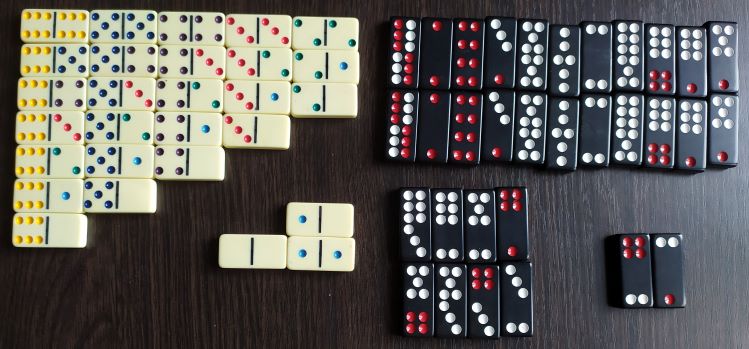
Comparison of European vs Chinese dominoes
The design of the [3:3] tile differs from other tiles, and on the [6:6] tile, half of the pips are colored red. Chinese tiles are also usually larger than their European counterparts.
Civil and Military tiles
There is a direct connection between dice and dominoes. Each tile represents one of the possible outcomes of rolling two dice. Since two dice produce 21 distinct combinations, one might expect 21 tiles. But the Chinese set contains 32. Where do the additional 11 tiles come from?
Historically, the tiles are divided into two suits:
- Civil (Wen, 文)
- Military (Wu, 武)
Civil suit includes: all doubles, [6:5], [6:4], [1:6], [1:5] and [1:3]. All other tiles belong to the military suit.
The crucial difference is this: every civil tile appears twice in the deck, while each military tile appears only once.
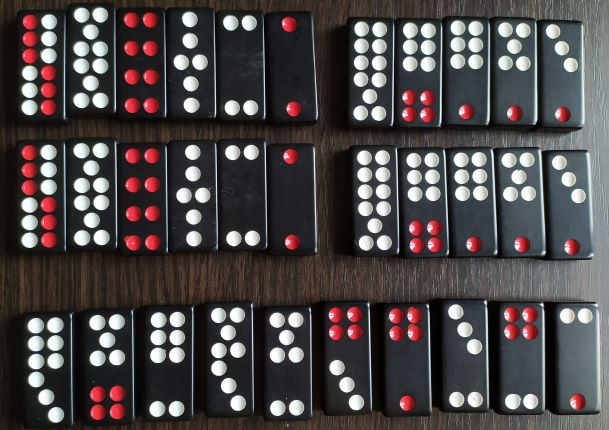
Civilian (above) and military (below)
This creates a structural asymmetry. Unlike European dominoes, there is no uniform distribution of values. If we ignore the doubles, we find:
- Eight tiles containing ones and sixes
- Seven tiles containing fives
- Six tiles containing threes and fours
- Five tiles containing twos
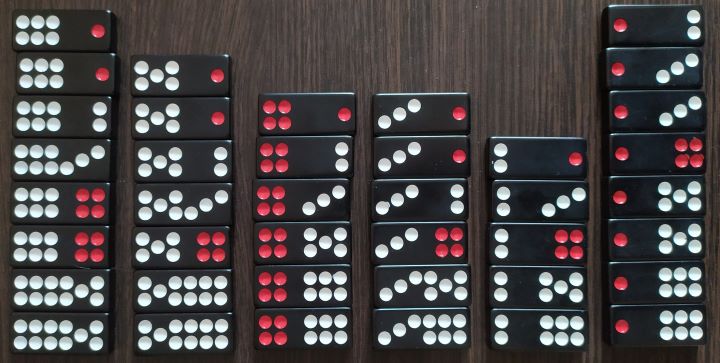
Asymmetry of the deck (in the photo - two sets of dominoes, without doubles)
How to Remember the Suits
At first glance, it may seem difficult to remember which tiles are civil and which are military. In fact, it is not so complicated.
Since all doubles are civil, you only need to remember five additional civil tiles:
- The two highest tiles with sixes (excluding the double): [6:5] and [6:4]
- The two highest tiles with ones: [6:1] and [5:1]
- The special tile [3:1], which symbolizes “Harmony” (or “Peace”)
The [3:1] tile is often simply called “the Goose” because of its visual resemblance.
Once these five are remembered, all remaining non-double tiles automatically belong to the military suit.
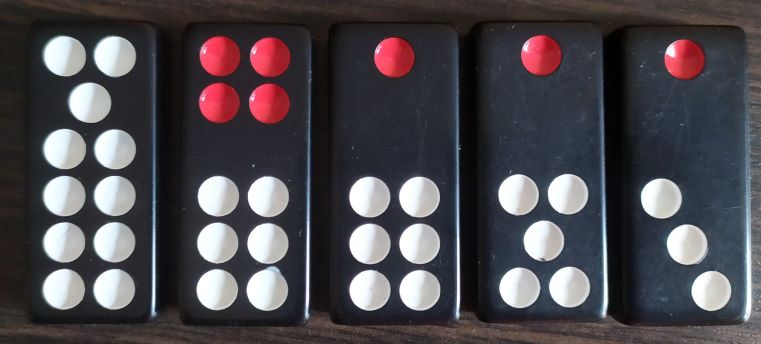
Civilian non-doubles
Buying or Making a Set
Chinese dominoes can be purchased online, especially from Chinese retailers. Search for Pai Gow or Tien Gow sets (read the description carefully to ensure you are buying dominoes and not baking molds).
If ordering from China, it may be wise to buy two sets, since a minority of games require exactly two full sets. Fortunately, they are not very expensive.
It is also possible to create a set using two standard European domino sets. Remove the unnecessary tiles, and paint: all ones and fours red and half of the pips on the double-six red.
Color matters in only a few games (notably not in Tien Gow or Pai Gow). The distinctive double-three design is purely aesthetic, and not all modern Chinese sets preserve it.
Playing Traditions
Before moving on to specific games, it is helpful to understand some traditional practices.
1. Gambling Tradition
Chinese domino games are traditionally played for money. Where gambling is restricted, playing cards may be used as substitutes for chips and exchanged later.
2. Building the Wall
After shuffling, the tiles are arranged into a “wall,” stacking several tiles on top of one another to form small towers — usually four tiles high. In practice, these towers are often less neat than photographs suggest.
3. Determining the First Player
The first player to draw tiles is determined by a dice roll.
4. Drawing Tiles
During the deal, players take tiles from the wall in turn, usually two at a time, though sometimes entire towers are taken.
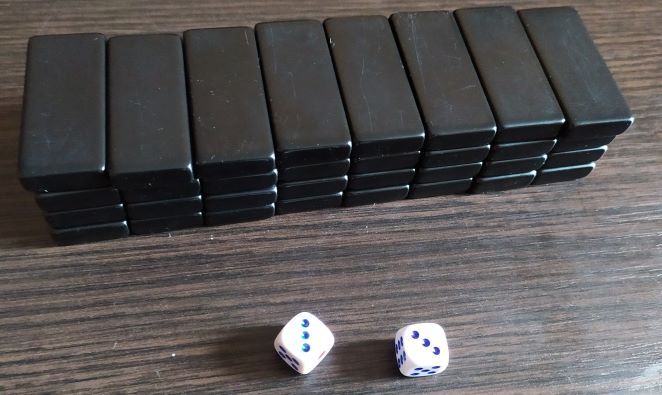
Chinese dominoes tiles “towers”
All of these traditions can be simplified if desired. Scoring can be converted into ordinary points instead of money. Tiles may be dealt in a European manner. These adjustments do not affect the mechanics of the games — they merely reduce the traditional atmosphere.
Reduced and enlarged decks
A standard Chinese domino set contains 32 tiles. However, not all games use this set. Sometimes two sets are combined to create a 64-tile deck. There are also paper domino decks in circulation, sometimes consisting of 84 or even 105 cards. In such decks, all 21 distinct tile values are represented four or five times each.
In some games, however, tiles are deliberately removed to create a reduced deck. For example in the Korean connecting game Kko-li-but-i-gi doubles from [3:3] to [6:6] are sometimes removed, leaving 24 tiles. And a deck for Ding Niu game removes all military tiles except for [6:3] and [6:2] making this connecting game highly asymmetrical.
With this knowledge, you are ready to explore the first category of games - Connecting Games . They, unlike some other games, will look familiar.