Why Chinese Dominoes
There is such a thing as Chinese dominoes — and they differ from European dominoes in almost every way: appearance, composition, rules, and culture. In short, they are a completely different world.
Chinese dominoes, or GuPai (骨牌), literally “bone tiles,” are an ancient game that was once brought to Europe. There, it gradually changed and eventually gave rise to the familiar European dominoes. In Korea, the game was known as Golpae (골패).
Unlike European dominoes, GuPai is rich in symbolism. Almost every tile has its own character. This is not mysticism, but a natural consequence of the structure of the deck itself. The GuPai set is fundamentally asymmetrical, and that asymmetry gives each tile a distinct role.
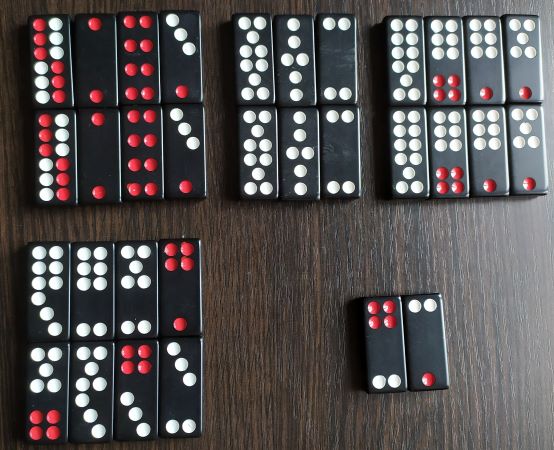
Chinese dominoes deck
The games played with Chinese dominoes are also far more diverse than those played with European dominoes. Tiles can form different types of combinations, which gives the GuPai deck greater depth.
Compared to Chinese dominoes, European dominoes feel very rational and logical. Chinese dominoes are more intuitive — even artistic. At first, GuPai can be difficult to understand. But once you become familiar with it, its beauty begins to reveal itself.
This may sound strange to someone who knows only European dominoes. A distant analogy might help: poker cards compared to tarot cards. Poker cards are like European dominoes — structured and straightforward. Tarot cards are more like Chinese dominoes — layered with symbolism and personality. In fact, Chinese dominoes were historically used for fortune-telling. However, here I will focus mainly on casual games. Many of them do not require symbolic knowledge, although the asymmetry of the deck is always present in the background.
Unfortunately, in its homeland, Chinese dominoes have significantly declined. In China, they were largely replaced by the visually more attractive Mahjong (麻将), and in Korea by the flower cards of Hwatu (화투).
Unlike Mahjong and Hwatu, GuPai is more versatile and supports a wider variety of games. However, it is less visually striking and requires some familiarity to appreciate. As a result, GuPai culture has gradually faded.
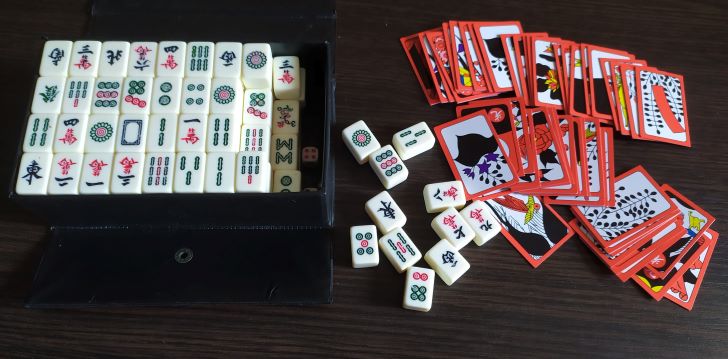
Mahjong and Hwatu which displace GuPai
Chinese dominoes have not disappeared completely. Today, older generations in China still play a limited number of games, such as Tien Gow and Ding Niu. The most widespread game is Pai Gow, a gambling game played in casinos. In fact, it was because of Pai Gow that I was able to purchase a Chinese domino set.
Still, the decline of GuPai culture continues. Younger generations show little interest in the traditional games. Casinos are prohibited in mainland China, so Pai Gow survives mostly outside the mainland. At the same time, Pai Gow is too complex for most Europeans to play casually. As a result, GuPai’s position continues to weaken.
I became sufficiently intrigued by GuPai to explore it in depth. There is an old American book that describes several Chinese domino games that are barely mentioned in modern Chinese sources. At the same time, Chinese sources describe games that are almost unknown in the English-speaking world.
I have tried to bring together information from many different sources. Unfortunately, the rules are not always clearly described, and reconstructing some games can be difficult.
To clarify disputed points, I wrote a computer simulator of GuPai and used it to test rule interpretations. It is open source here:
https://github.com/navpil/gupai
It is not a video game, but rather a working tool that allows me to experiment with the rules.
While developing this simulator, I searched extensively for materials, translated texts from Chinese and Korean, watched videos of elderly players — sometimes even frame by frame — and compared multiple sources.
In the process, I was able to organise my knowledge of Chinese dominoes and reconstruct the rules of nearly all GuPai games that are available in open (and occasionally even restricted) sources. There are still details I do not fully understand, and I will point them out where necessary.