Tien Gow
In the West, when people say “let’s play dominoes,” they usually mean a blocking game. In China, however, “playing dominoes” most often refers to a trick-taking game, similar in spirit to Whist.
There are Western trick-taking games played with dominoes, but they are relatively rare.
Most Chinese trick-taking domino games are closely related and can be seen as variants of one main game: Heaven-Nine (天九, Tianjiu or Tien Gow). They use the same suits, the same tile ranking, and the same system of pairs.
I have already described the ranking of tiles and pairs in the article The seniority of tiles and pairsIf you have not read it yet, it is strongly recommended.
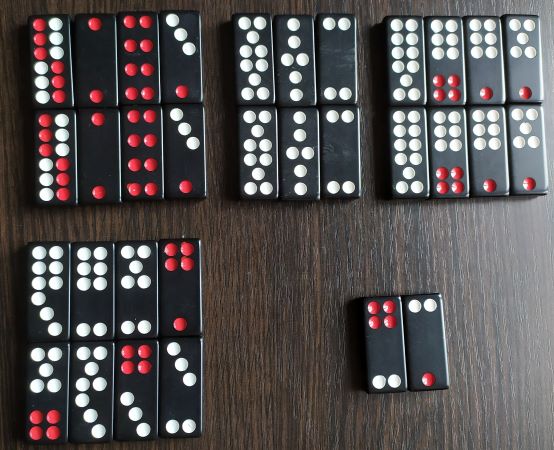
As a reminder, here is a photo of all the pairs (11 civilian, 4 military and 1 supreme):
The only trick taking game which is not a Tien Gow variant is Deer Hunt, which has its own page.
Basic rules
Tien Gow is played with a standard set of 32 tiles.
- Four players take part.
- Each player receives eight tiles.
- The banker leads to the first trick.
In the first round, the banker is chosen by lot. In later rounds, the winner of the previous round becomes the banker.
The player who wins a trick leads to the next one.
To lead a trick, a player may play:
- a single tile, or
- a valid combination of tiles (see below).
Each following player must either:
- beat the played tile or combination, or
- place the same number of tiles face down.
If the trick was started with a single tile, it can be beaten only by a higher tile of the same suit.
If it was started with a combination, it can be beaten only by a higher combination with the same structure (same number of civilian and military tiles).
After all four players have played, the player who played the highest tile or valid combination wins the trick and takes all the tiles. That player then leads the next trick.
After the final trick is played, the round ends. The player who takes the last trick is the winner of the round.
The winner becomes the banker for the next round.
Important Differences from Western Trick-Taking Games
Although the general idea is similar to games like Whist or Skat, there are important differences:
- You are not required to follow suit.
- You are not required to try to win the trick.
- If you cannot or do not wish to beat the trick, you place your tiles face down.
- A trick may begin with a combination, not only with a single tile.
- If you win a trick that consists of multiple tiles, you score that many tricks. (For example, winning a three-tile combination counts as three tricks.)
- The winner is the player who takes the last trick — not the one who takes the most tricks overall.
This last rule makes the strategy quite different from most Western trick-taking games.
Combinations
Pairs
The classical two-tile combinations are:
- Civilian pairs
- Military pairs
- The Supreme pair
Civilian pairs can only be beaten by higher civilian pairs.
Military pairs can only be beaten by higher military pairs.
The Supreme pair cannot be beaten — but it also cannot beat anything else, since it forms its own special category.
Historically, only pure pairs were allowed. Mixed combinations did not exist.
Mixed Civil–Military Combinations
In modern play, mixed combinations are often allowed, but only in specific, structured ways.
- Military ranking: Nine – Eight – Seven – Five
- Civilian ranking: Heaven – Earth – Man – Harmony
Because of this parallel structure, only the following mixed combinations are valid:
- Heaven + Nine
- Earth + Eight
- Man + Seven
- Harmony + Five
Mixed combinations can consist of:
- 2 tiles (one civilian, one military)
- 3 tiles (two civilian + one military, or the reverse)
- 4 tiles (two civilian + two military)
A combination can only be beaten by a higher combination with the same composition of suits.
For example:
If someone leads with Earth–Earth–Eight, it can only be beaten by Heaven–Heaven–Nine, not by Heaven–Nine–Nine. Structure matters.
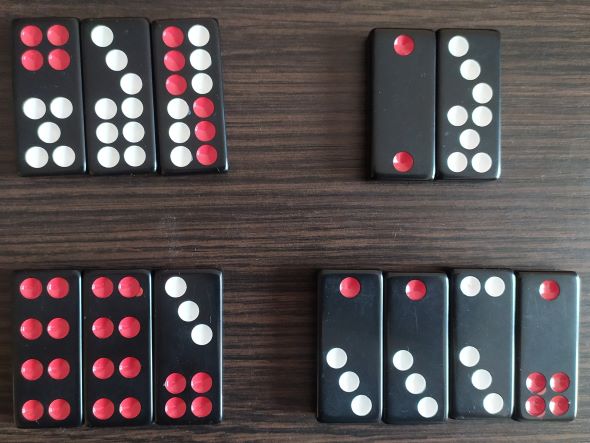
Mixed pairs examples
Scoring
The player who takes the last trick wins the round. All payments are made to or from the winner.
If a player took no tricks at all, he pays 5 chips to the winner.
Otherwise, the number of chips exchanged is calculated by formula:
4 − (number of tricks taken)
Examples:
- 1 trick → pays 3 chips (4 − 1)
- 4 tricks → pays 0 chips
- 6 tricks → receives 2 chips from the winner (4 − 6 = −2)
Even if the winner must pay some chips to a player who took many tricks, the winner will still receive more overall from the other players.
All payments involving the banker (that is - the person who lead to the first trick) are doubled:
- If the banker wins, all payments to and from the banker are doubled.
- If the banker loses, he pays the winner double.
Optional rules
Increasing Banker Multiplier
Some groups use a rule where a banker who keeps winning increases their multiplier by one each round.
- First win as banker → ×2
- Second consecutive win → ×3
- Third consecutive win → ×4
When another player wins, the multiplier resets.
In this version, unusual situations can occur. For example, the banker might take many tricks but not the last one, and due to the multiplier the winner may end up paying more to the banker than they receive from others.
To prevent this, a common adjustment is:
If the banker took more than four tricks but did not win, payments between banker and winner are calculated at the normal rate (not multiplied).
This increasing multiplier adds a stronger gambling element, so it is optional.
Early Death Rule
Another optional rule is called “early death.”
If the final trick consists of a single tile, any player who has not yet taken a trick must discard face down — even if they could win the trick.
This prevents a strategy where a player saves a strong tile, avoids taking tricks all game, and tries to win only the last one.
However, if the last trick is a combination (not a single tile), a player who has taken no tricks may still attempt to win it.
Sources
Description on English Wikipedia
Description on Pagat
You can try playing this game against a computer on the Online Domino Games website