Symbolism in Chinese Dominoes
The origin of dominoes is closely connected to dice. A domino tile can be seen as representing a throw of two dice. However, from a mathematical point of view, the two are not exactly the same.
With dice, a double appears half as often as a non-double. If dominoes followed this probability strictly, there would be 36 tiles: each double appearing once, and each non-double appearing twice. In reality, the Chinese domino set contains 32 tiles.
There is another difference. When a domino tile is drawn and placed on the table, the probability of drawing the same tile again decreases — and if it is unique, it disappears entirely. With dice, however, every throw has the same probability as before. But this is only a modern mathematical observation. A thousand years ago, there was no probability theory.
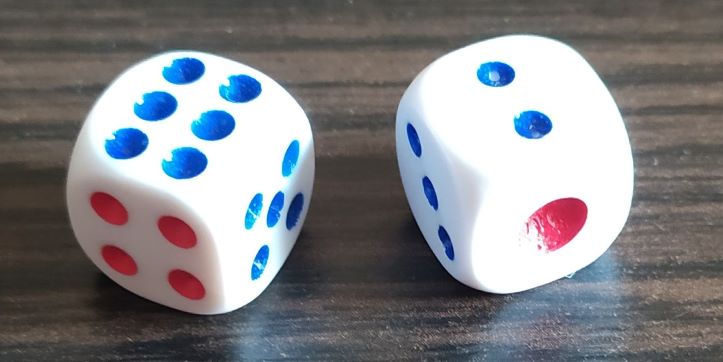
Chinese dice
Red Pips and Their Meaning
On Chinese dice, the ones and fours are red. The domino tiles follow this tradition. But why are these numbers red?
One legend says that an emperor once needed to roll a four and a one to win a dice game. He succeeded, and in celebration ordered all ones and fours to be painted red — the color of success and happiness.
Another explanation is symbolic. One and four are considered unlucky numbers. One is the lowest possible value. The number four sounds similar to the word “death” in Chinese, giving it a reputation somewhat like the number thirteen in Europe. Painting them red — the color of joy and good fortune — may have been a way to balance their negative meaning.
We may never know the real reason. It is also possible that a long-forgotten game gave special importance to one and four, and the colors simply remained after the game disappeared.
Civil and Military Suits
There is at least one historical dice game that used the same two suits as dominoes: Throwing Heaven and Nines. In that game, the banker threw the dice, and the player had to match or beat the combination within the same suit.
The two suits were:
- Civil (文, Wen)
- Military (武, Wu)
The pair Wen–Wu has deep philosophical roots going back to Confucian times. Over time, it became associated with the broader Yin–Yang worldview.
Civil represents culture, learning, creativity, and peaceful governance. Military represents force, power, and rule during times of war.
The Dao De Jing (chapter 31) mentions the “left” and the “right,” suggesting that the emperor was advised by two ministers — one civil and one military — seated on opposite sides. The civil side traditionally had precedence. Also there are more civilians than warriors in the real world, and perhaps this is one of the reasons why the number of civilian tiles was doubled.
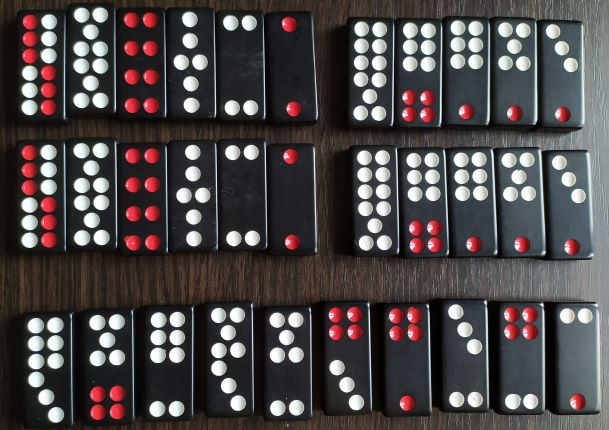
Civilian (two top rows) and Military (bottom row) tiles
Before the Civil–Military terminology became standard, the two suits were sometimes called Hua (華) and Yi (夷) — meaning “Chinese” and “Barbarians” (a similar cultural division existed in ancient Greece). After the rise of the Qing dynasty, whose rulers were not ethnically Han Chinese, the older terminology may have been politically sensitive. Renaming the suits Civil and Military was more neutral.
Symbolism of the Civilian Tiles
The logic behind assigning tiles to one suit or the other is not entirely clear, but some patterns can be observed. First, all doubles are classified as civilians. Perhaps the love of symmetry plays a role here - “doubles should double” .
The highest double, [6:6], represents Heaven. In Chinese thought, Heaven is more than the sky; it is a source of order, wisdom, and truth. In some interpretations, it comes close to the idea of God.
The lowest double, [1:1], represents Earth. Earth is important, but in Chinese philosophy it does not stand in a dualistic pair with Heaven in the same way as Uranus and Gaia in Greek mythology or Nut-Geb in Egyptian mythology.
The double [4:4] represents Man. Together, these three - Heaven, Earth, and Man - form a central triad frequently mentioned in classical Chinese texts, including the Book of Changes.
Why does [4:4] represent Man? The exact reason is unclear. Perhaps because humanity stands between Heaven and Earth. Perhaps because fours are red, symbolizing blood. Or perhaps because four sounds like “death,” and mortality defines the human condition.
After these three comes [3:1], called Harmony. One interpretation is that Heaven, Earth, and Man (three) should live in harmony as one. Modern Chinese players, however, often call this tile “Goose,” because it resembles a white goose with a red beak.
A goose
Next come the remaining doubles in descending order:
- [5:5] - Plum Blossoms
- [3:3] - Long Triples
- [2:2] - Bench
Here the symbolism becomes more visual than philosophical. The names are based mainly on appearance.
Four more civilian tiles follow, also ranked in descending order:
- [6:5] - Ax (or Tiger’s Head)
- [6:4] - Red-Headed Ten
- [6:1] - Long-Legged Seven
- [5:1] - sometimes called Red Hammer Six
Why these four? All of them symbolically contain Heaven, Earth, or Man.
- In [6:5], the six represents Heaven; five can be seen as Man plus Earth (4 + 1).
- [6:4] and [6:1] clearly combine Heaven with Man and Earth.
- [5:1] is more complex: 1 is Earth; 5 + 1 = 6 (Heaven); and 5 − 1 = 4 (Man).
It’s hard to say whether these interpretations are original, but at least they help with remembering which tiles belong to civil suit.
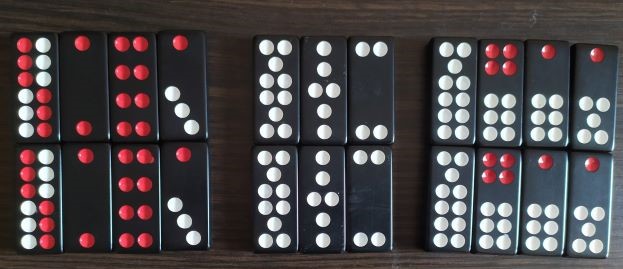
Civilian tiles in descending order - heaven, earth, man, harmony and so on
The Military Tiles
All remaining tiles belong to the military suit.
Here the system is simpler. There is no strong philosophical symbolism. The tiles are ranked mainly by the total number of pips: the higher the total, the stronger the tile. If two tiles have the same total, they are usually considered equal.
Military tiles are often named by their pip totals — Nine, Eight, Seven, Five, and so on.
Two tiles are somewhat special: [4:2] and [2:1]. Although their totals are six and three, they are not commonly named that way. In some games they receive special names such as Mother and Son.
From these dice combinations, the domino tiles were formed — with the entire civilian suit duplicated, creating the distinctive asymmetrical 32-tile set.