Jjak-mat-chu-gi
A Korean collecting game originally called 짝맞추기, described by Stewart Culin. It can be played by two to four players.
The objective is to collect three classic pairs. Since this is a Korean game, military tiles are paired according to the Korean pairing system.
Each player gets five tiles, except for the first player who gets six, the rest form a deck.
The first player lays out all the pairs, if he has them, and discards one tile.
Each subsequent player can either:
- take the last discarded tile, provided he can pair with it
- take a tile from the deck.
Then he lays out a pair, if he has one, and discards one tile face up.
The game is played counter-clockwise until one of the players collects three pairs.
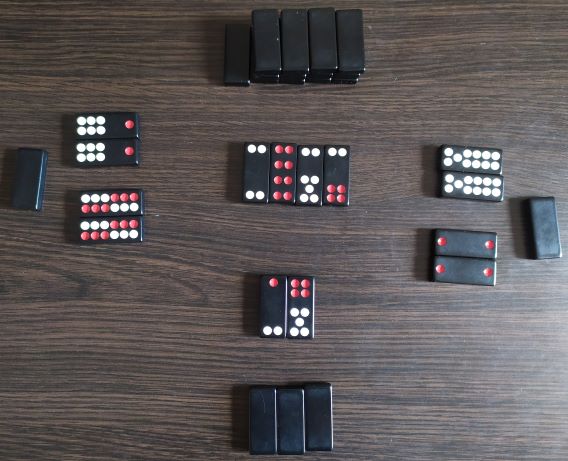
Game in progress, the deck is North, Southern player has one military pair in a Korean way
Forming classic pairs is quite straightforward, so the game does not require much effort. Whether this simplicity is a strength or a weakness is a matter of taste.
Rules analysis
As described, the game frequently ends in a draw - when no player manages to collect three pairs. In a four-player game, almost 90% of games may end without a winner, which makes the game rather static and, arguably, less engaging.
Since Culin’s descriptions are not always entirely reliable, it is possible that some detail was omitted.
If one introduces the rule that any player - not only the next one in turn—may claim the most recently discarded tile, provided that a pair is immediately laid down with it, the statistics improve significantly. In that case, only about one game in ten ends in a draw. When a player claims the discarded tile and lays down a pair, play continues from that player. If no one claims the tile, the turn passes as usual. This rule is not arbitrary: a similar mechanism exists in Mahjong, the most widespread collecting game in China.
There are other possible adjustments. For example, when the deck runs out, all discarded tiles could be shuffled and reused. However, the previous solution seems more consistent with broader East Asian collecting-game traditions.
An online version of the game can be tried here: http://www.onlinedominogames.com/jjak-mat-chu-gi
The rules on that site are based on Pagat, so the tile pairing follows the Chinese system rather than the Korean one. However, this does not substantially affect the gameplay itself. The author of that version addresses the draw problem differently: instead of requiring three pairs to win, players simply score one point for each collected pair. In this format, reaching three pairs is no longer necessary.